I'm thrilled I get to tell you about two fantastic courses coming up. First, Julie Hedlund has opened her How to Make Money as a Writer course. I'm fortunate to be in the beta course. I'm learning how to use social media to market yourself, how to market yourself off-line, and how to create the mindset of an authorpreneur. And now her course is open to everyone! Click here for the details: https://juliehedlund.leadpages.net/makemoneyasawriter/ I've also graduated from Mira Reisberg's Children's Book Academy--see my nifty graduation button?I took her course on writing picture booksandso enjoyed my experience with Mira that I'm tempted to take her illustration course even though I'm not an illustrator. But for those of you who are illustrators or who would like to be, I unabashedly recommend her illustration course. Check out her great introductory video with co-teacher Kristine Brogno, design and art director for Chronicle Books.
It's starting soon and if you register before Wednesday, you get a discounted price. I'm sorry for not posting this sooner, but I'm waist deep in work from our move and a few other unexpected things. I can't wait to share more with you about what I've learned from these two talented women. Have a great day!
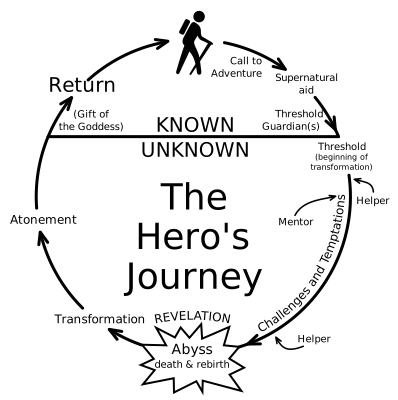
I read an interesting post today about atypical story arcs, by Joyce Audy Zarins. Instead of the usual rise and fall (pictured above), some story arcs take on less traditional patterns, like the "X" shape arc in Bridge to Terabithiawhere Jesse and Leslie switch roles by the end.
I tend to follow the heroes journey arc the most, but I'm intrigued with the idea of using an arc as an integral part of the story rather than a plot mapping tool. Joyce also mentioned the cyclical arc of Holes, by Louis Sachar, and how fitting that is to the title and development of the main character. I started looking around for other ideas about arcs and ran across a lecture by Brandon Sanderson. He briefly talks about non-traditional arcs but then answers a student's question about collaboration, also an interesting topic and pertinent to a discussion on arcs.
I'll leave this here for now. More on arcs later as I churn up additional research, but I'm currently enrolled in two writing courses that are keeping me busy, Mira Resiberg's The Craft and Business of Writing Children's Picture Books and Julie Hedlund's soon-to-be-released course on marketing for the authorpreneur. More on both of those later. I'm also churning away at my middle grade novel and revising a handful of picture book ideas I think have the most potential. Between all that, I'm organizing a children's lit group in my new home as I did in my previous home. There is no SCBWI chapter here, but I'm trying to lay the ground work for establishing one. It's been a busy but fruitful transition. Hopefully I'll have more good news to share in the near future. Happy writing.
For those who've read my post about humor, this will be a fitting follow up. I've been trying to pay attention to different types of humor as I've gone about my daily routine. I caught the video above on Facebook last week and enjoyed it.
As you watch it, try to hear the words separate from the visuals. The words are hilarious alone and when added to the context of the video, it's brilliant. Of course, the compilers of the video didn't create any visual humor, they just capitalized on existing footage by adding some pretty funny (and family friendly) verbal humor.
But illustrators have loads of opportunities to create visual humor in subtle and not-so subtle ways. Looney Tunes creators were masters at this, which is why their appeal crosses generations. One of my favorite Bugs Bunny cartoons is a perfect example of how an illustrator (and how an author with carefully played art notes) can add multiple layers of humor. Notice the name plates of the knights in the following clip:
Now moving into this century, I finally watched the Life of Pi. So much understated humor, which I love, but my favorite line of the moviehad to be when Pi's father was talking about their move from India to Canda:
Pi's Father: "We will sail like Columbus."
Pi: "But Columbus was looking for India!"
I wish I could have found a video clip for that scene, but this behind the scenes video captures some of the humor a lot of beauty that went into the film.
I hope something tickles your funny bone and your funny pen and I hope you have a great weekend.
I'm still settling into to our new home, but had the fortune of watching the video above. It's an interview for SCBWI, of Julie Hedlund, author and founder of 12x12. The publishing world is adapting and Julie's interview exposes one way to think outside the traditional methods of getting published. It's definitely worth viewing.
On another note, I joined WriteOnCon for the first time this year. We had the chance of having agents view our queries and first five pages or first 250 words. I posted a middle grade novel I've been working on and a picture book. I can't say I got any agent comments, but I definitely benefited from the other writers' comments who graciously took time out to critique my stories. Forums like 12x12, Verla Kay's Blueboards (now the SCBWI Blueboards), PiBoIdMo, NaNoWriMo and WriteOnCon are all great ways to meet other writers and learn the ins and outs of the publishing world for anyone seriously considering a plunge into the world of writing. And to take a page off of Leandra's blog, here's my favorite line from my historical-fiction, middle grade novel that I posted in WriteOnCon:
I heard the screen door slam and saw my father’s shadow skirt the corner and disappear. The truck started up and the sounds of it pulling away masked the clanging of the pots coming from the kitchen.
Whatever my mom was doing stopped when Grandma entered. She rarely came out of her room, but when she did, we had to be on our best behavior.
As posted previously, I hosted Erin Cabatingan, author of A is for Musk Ox in my former home for a workshop on writing with humor. Now that I'm finally settling into our new home, I'm cobbling her wisdom in a post. I apologize that I haven't been around to read the great posts you all are putting out there as well. Back to my notes from Erin's presentation: What is humor? Author Rick Walton says, "Humor is surprise without threat of promise." So what does that mean? You have to surprise the reader without making them feel threatened.(For Rick's essay on humor, see here.)
Humor is hard to teach someone. Read lots of humorous books until it becomes part of you. You can use humor for a laugh-out-loud experience or just a smile, or even to make a serious topic more light-hearted.
Where can you find humor? Observe children and add it into book, but be careful when using true to life examples of children--don’t make fun of them. You can use real examples and make them safe by making sure the child reader feels superior to the character in the book. They can laugh at the way they used to be. (Example: Kel Gilligan'sDaredevil Stunt Show, by Michael Buckley).
Watch kids for funny things and adults. Watch animals—they do funny things too. (Example: Doggone Dogs, by Karen Beaumont) .
Humor can use wordplay where you take a word and switch out a syllable like Chimpansneeze, by Aaron Zenz or Zombelina, by Kristyn Crow. (Note: Erin said Kristyn looked up zombie jokes to find the puns for her book.)
Humor can be found in conflict. Have characters believe different things or want different things. In Erin's books, A is for Musk Ox and Musk Ox Counts, Musk Ox and Zebra are at odds on everything, which creates the humor that drives the plot and fleshes out the characters.
Humor can share inside jokes but you have to set it up for the reader or use established knowledge in order to make it work. (Example: The Three Silly Billies, by Margie Palatini.)
Humor can can come from an established pattern that the writer breaks unexpectedly. (Example: Yes Day, by Amy Krouse Rosenthal) Humor can bend language. The way you say things can be funny. (Example: Moo Who?, by Margie Palatini.) Use the sounds of words, onomatopoeia, to add in humor, or play with expressions and accents. (Example: The Dirty Cowboy, by Amy Timberlake.)
Let the illustrator add humor to the manuscript by giving them ridiculous or fun situations to illustrate. Try to think visually. Think of your text as illustrations and try to visualize how the illustrator might see it. Make a dummy. Let the illustrations tell all or part of joke. Have the text and illustrations disagree. (Example: A Vampire is Coming to Dinner, by Pamela Jane.)
Warning: When you do add humor be conscious of what different ages find funny, you don’t want it to go over the child’s head. (Link to age-appropriate humor suggestions: http://www.darcypattison.com/picture-books/what-kids-think-is-funny.) As you can see, it was an excellent workshop. I haven't included all my notes, but these should get you started. And in the immortally funny but sage words of Dave Barry:
"Most people have a sense of humor that's good...Some people don't. I feel sorry for those people. The humor impaired. I got a lot of letters from them, so I know they're out there. Specifically, there are a couple things [to write humor] I think you need to do. You need to have a real strong sense of pacing. Too many attempts at humor fail because A, either it takes forever to get to what's supposed to be funny and just wanders around before it gets there, doesn't seem to be any purpose. Or once it gets there, it says it over and over and over, it doesn't get out of there, you know, quickly. So, I think it's a lot like stand-up comedy, in a sense, you don't let the reader see it coming, you hit the reader with it, and then you get out of there and go to something else the reader doesn't see coming. And that's probably the most fundamentally important thing. The other thing is, it's work to write humor...if you're gonna write humor you have to take it just as seriously as if you were gonna write about anything else. You have to really work hard to get it to work."
In the summer when my little one is not in school, uninterrupted time is hard to come by. And bedtime is hard to enforce when it stays light until 10 pm and all the other kids are out playing. So I gave up on bedtime. Whenever I can get him to bed, I go to bed too, and then I have time in the morning before he wakes up. I get up, go straight to my studio or computer and work until he wakes up, sometimes eating breakfast between lines. A benefit I didn't expect is that my work is on my mind throughout the day and I keep going back to it whenever I have a few minutes. Because I started my day with what I love, I'm thinking about it instead of menial tasks. My mind is generating ideas when I'm doing other things too, which pulls me back to my computer or studio. Just as going a few days without writing or making art makes it hard to get back into, starting my day that way keeps me in it.
Our regional kid lit group hosted a workshop on writing with humor by Erin Cabatingan, author of A is for Musk Ox and Musk Ox Counts. If you've read her stories, you know she gets humor. If you haven’t read her stories, you are seriously missing out. (See the trailer above.)
I took copious notes from her excellent workshop, but I was also able to ask Erin questions about her personal writer's journey and that is what I will share with you today:
Q: What was the evolution of your journey to find an agent and when did your Musk Ox books come into that phase?
A: My publishing journey started in college when I took a class about writing for publication. That was when I first started to understand how to actually go about getting published. Starting then, I began writing and submitting my work, but I didn't do much else to improve my writing or increase my knowledge of how publishing worked. It was about six years before that I got really serious about trying to get published. I joined a critique group. I started reading tons of blogs about publishing. I worked a little with Rick Walton, who helped me understand what it took to get a manuscript submission ready. I went to my first conference and workshop. It was also then that I decided I definitely wanted an agent. My A is for Musk Ox book came into the whole process at about this point. I had my musk ox book, and another one about a toucan that I really liked, and I took turns submitting them to different agents. When an agent rejected one story, I would send them the other.
After receiving lots of rejections, life got in the way and I stopped submitting manuscripts to agents. At the time, I thought I had received rejections from all the agents I had submitted to, so months later, I was surprised to get a voice mail from Nancy Gallt telling me that she was interested in representing A is for Musk Ox.
Q: Where did the idea for your Musk Ox character come from?
A: I needed an animal that began with “m," so I found a website that listed "m" animals. Musk Ox happened to be the first one that I liked. The personality of the musk ox came as I wrote the story.
Q: How did you pitch to your now agent? Did she contact you right away or ask for revisions first? What was the process?
A: I was one of those dredged from the slush pile. I wrote a query letter to Nancy Gallt, having no connection to her at all--I hadn't met her at a conference or anything like that--and she liked my manuscript enough to want to represent it. In fact, she already had an editor who was interested in it when she contacted me.
Q: What were some pivotal moments in your search for an agent that got you to the point you’re in right now?
A: Probably the most helpful thing was my "internship" with Rick Walton. He's the author of over 90 published books, many of which are picture books. He had projects for me to work on and in return, he would help me with my manuscripts. The projects themselves helped me become a better writer.
One thing he had me do was go over editors'/agents'/authors' blogs and find all the parts that talked about how to be a better writer. That really helped me understand the publishing world better. And then he worked with me on my writing. With his help, I drastically changed a manuscript I was working on and made it much better. I haven't yet published that manuscript, but I learned so much from working with him on it. And maybe one day it will get published.
Q: Did you have a writing background? What did you study in college?
A: I didn't finish college--all I managed to do was get my general education requirements done. And the only writing background I have is what I did in high school and the two writing classes I took in college, one of which was writing for publication.
Q: Once you landed your agent, what has changed for you as a writer, mom, wife, person?
A: I’m not embarrassed to tell people that I'm a writer any more. I'm still shy about mentioning it, but not embarrassed. I also don't feel quite as guilty spending my time writing, since there's a little more hope that I might sell something else. Or at least I can tell myself that. Other than that, I can't really think of anything. Maybe more will change if/when I write a book that is much more popular, or if I sell more manuscripts.
Q: Any favorite moments/responses when talking to or hearing back from readers of your books? A: I’ve had a few. There was one time when I went to the book fair at my kid's school. They had A is for Musk Ox there, and I overheard one lady gushing to the PTA president and cashier about how much she loved my book. That was really fun to hear.
It's always fun when I meet someone who has read my book, likes it, and is excited to meet me. That's only happened once or twice, but it's pretty fun. It's also fun to hear kids laugh when I read one of my books to them. That's maybe my favorite.
Q: When is the third book in the Musk Ox family coming out?
A: September 30!
Q: What are your favorite picture books?
A: Besides my three picture books? Hmmm. That's a hard one. I really like Where the Wild Things Are, probably in part because I remember reading it with my dad. I still remember rolling my terrible eyes and gnashing my terrible teeth with him. I like There's a Nightmare in My Closet, King Bidgood's in the Bathtub, Bedtime at the Swamp, Click, Clack, Moo: Cows that Type, and many others.
Q: Name your favorite part in your books.
A: That’s another hard one. Probably the holes in their covers. I had mentioned having a hole in the manuscript for A is for Musk Ox, but I wasn't sure they would actually put one in because I knew it would cost more money. I was excited to see it there. I wasn't expecting a hole in Musk Ox Counts, so that was fun to see. And the third one has a hole as well! Holes are fun.
Q: What advice do you have for writer’s struggling to land the agent or publishing deal?
A: Keep going! If you love writing, and want to be published, don't ever stop trying. Keep improving your craft--search the internet for information about writing and publishing, go to conferences, have others look at your manuscripts, read books. Eventually you'll make it. Just don't give up.
Erin is repped by Marietta Zacker at Nacy Gallt Literary Agency.